TensorTarget · An AI co-scientist for drug-target discoveryComing soon
Prioritized, mechanistic, testable drug-target hypotheses — accelerated by an AI co-scientist built by TensorOmics.
We turn human genetics, single-cell, and other omics data into a ranked set of mechanistic, testable drug-target hypotheses — every hypothesis grounded in evidence and reviewable by a human scientist.
In active development — be one of our first design partners. Hypothesis-generating, evidence-grounded, expert-curated: we surface and rank testable hypotheses with their evidence — we don’t claim validated or autonomous results.
Become a design partner →What it is
Most target lists come from a single lens — a genetics score, or a pile of differentially-expressed genes — with the other layers stitched together by hand, one gene at a time. No one can weigh it all — genetics, expression, networks, druggability, literature, across thousands of genes — holistically, by hand.
We do something sharper: start from genes with human genetic causal evidence, map each to the cell type where its biology is dysregulated, trace signalling to effectors through protein networks, and layer in druggability. An AI co-scientist then generates, critiques, and refines hypotheses — every claim cited to the evidence — and human scientists review and curate each before it reaches you.
The win is leverage: the same reasoning a target-ID expert would apply, run across every layer and every gene at once. Expert hours stop being the bottleneck — your scientists are freed from the grind to focus on the science.
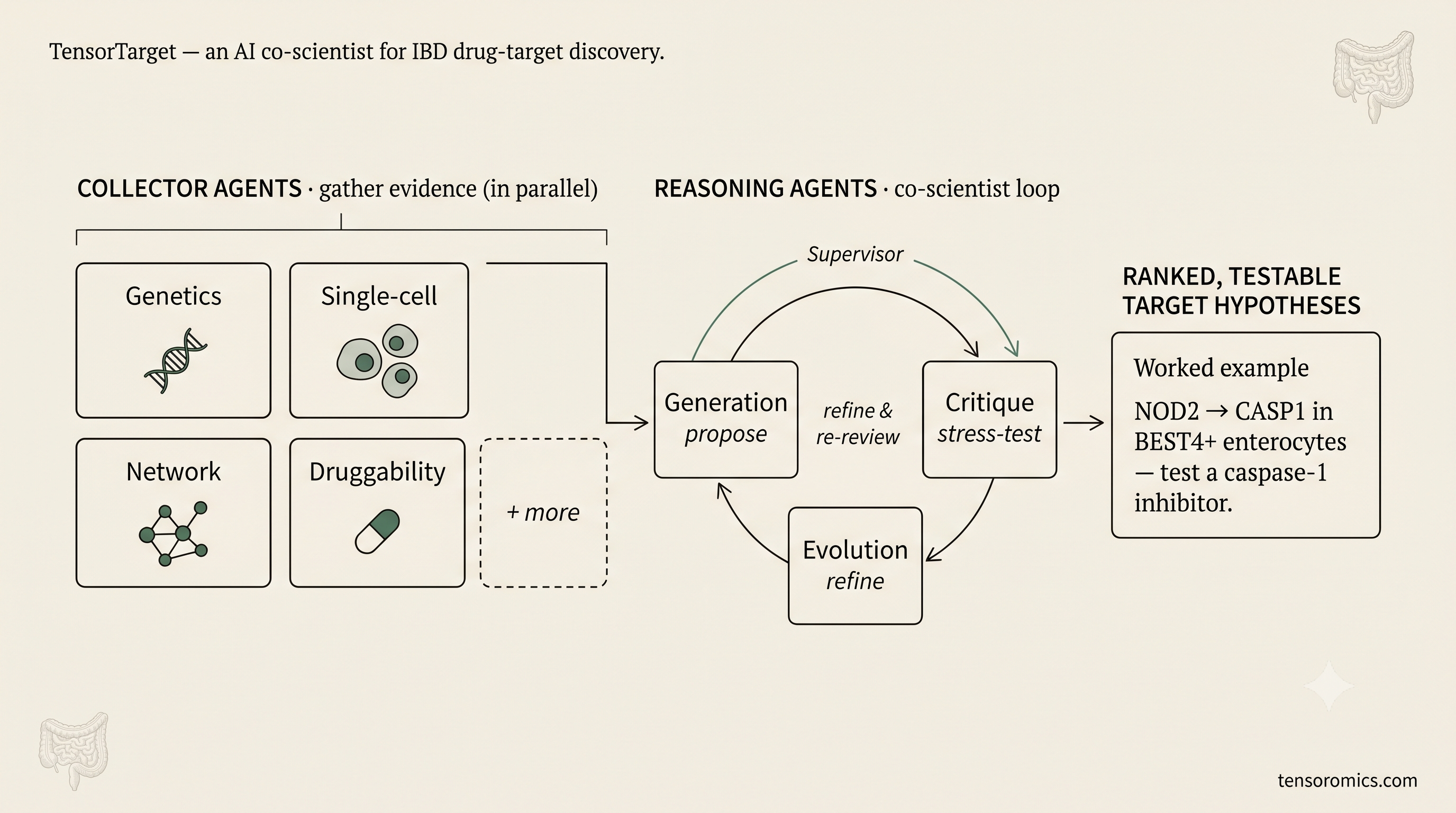
What you get
- A ranked set of candidate target hypotheses for your indication
- For each hypothesis: the cell type it acts in, the mechanism, the genetic + expression + network evidence, known drugs & druggability, and a suggested validation experiment
- Full provenance and caveats — including what we considered and why we set it aside
- A walkthrough call with the analysis
Why it’s different
Genetics-first
causal human-genetic evidence, not just correlation or expression.
Cell-type-resolved
where a target acts, not only whether it matters.
Grounded reasoning
citations + adversarial self-critique, not a black-box score.
AI co-scientist + human review
human scientists review and curate every hypothesis — that pairing is why the output is trustworthy.
You’re in the loop, too
Your team’s data and judgment shape the analysis — bring your own data and your own hypotheses into the loop.
Bring your own data
Add your internal omics, genetics, or clinical datasets and we run the analysis over them alongside the public evidence — not just public databases.
Seed your own hypotheses
Have a target or mechanism in mind? Hand it to the co-scientist as a starting hypothesis — it gets generated, critiqued, and refined with the rest, and you see the evidence for and against.
Want early access?
TensorTarget is in development. Be one of our first design partners — bring a real indication and help shape it.
Become a design partner